
I wrote an enthusiastic post early in 2024, most of which still appears below, although I have given it a new title and edited parts out which don’t sit comfortably here and belong instead on my artist page. In fact, I don’t know why I put them here in the first place. Maybe to prove to myself that I had been doing something. For an update of what actually happened in 2024, see Reflections on Art for 2025. I intend to add to it, so it becomes like a mini-diary of the year, although specific events and comments will go in the Posts as usual.
HERE’S WHAT I SAID AT THE START OF 2024:
So much is happening in the visual arts world, I have been struggling to keep up. The technology itself has gone crazy, I was working away to harvest my projects but finished up flat on my back exhausted by the relentless sun.

Painting en plein air, weekly classes with a great teacher, experiments with new brands and styles of paint, going from acrylic to oils and back again, reading blogs and newsletters, moving between houses, making endless decisions: the end of 2023 was a welter of uncertainty.
Now it’s time to focus. Art, and painting in particular, is such a strange process. Writing about art only makes sense if others want to read about it. There are so many competing distractions. Many practicing artists have little or no interest in anything written about art, theoretical or academic. Art lovers want to know more, but their main interest is often in the artist’s life. Biographies and biopics make you feel like you know the artist, but actually, you don’t. Apart from critiques and commentaries on pictures, or on the artist, not much is written about the practical experience of art-making for the general reader, as against technical manuals for the student. I’d like to include some more techie stuff here, especially on things like paint quality, colours, new products and so on.
Another genre of art-writing is the huge amount of hype around the art-market. I subscribe to several international bulletins on what’s happening in the art-world, and will probably start putting a few notes in posts here. Nothing could beat the art-market in the 1800s, though.
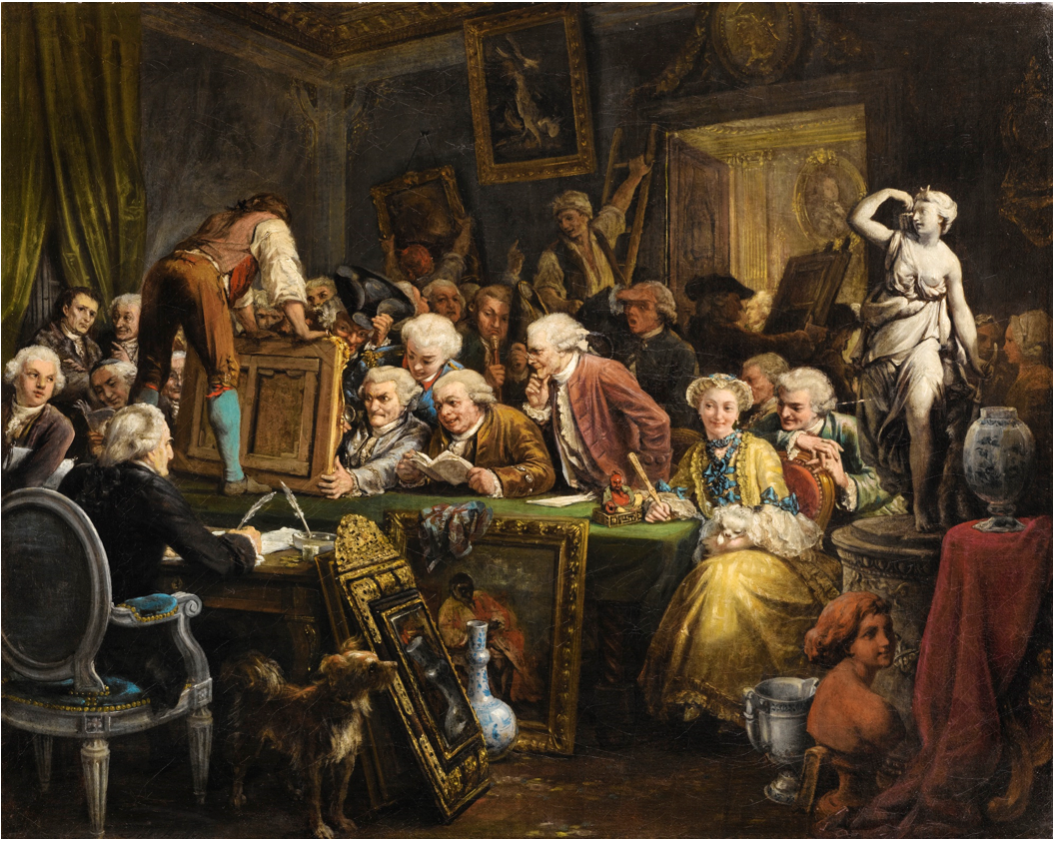
The Auction. Julien-Leopold Boilly. Paris, 1796-1874. Oil on canvas, 50x62cms, 1800s (exact date not known: Wikimedia commons).
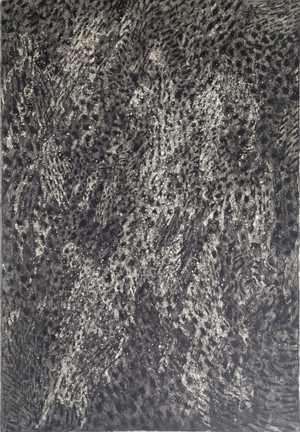
I love to write about art because I love to think it. It is magical and mysterious. I was once taken with the idea of the Void, related to concepts such as Black Holes and other way-out stuff in modern physics and cosmology. I explored the Void in contemporary art in my prize-winning essay on the work of Anne Judell here.
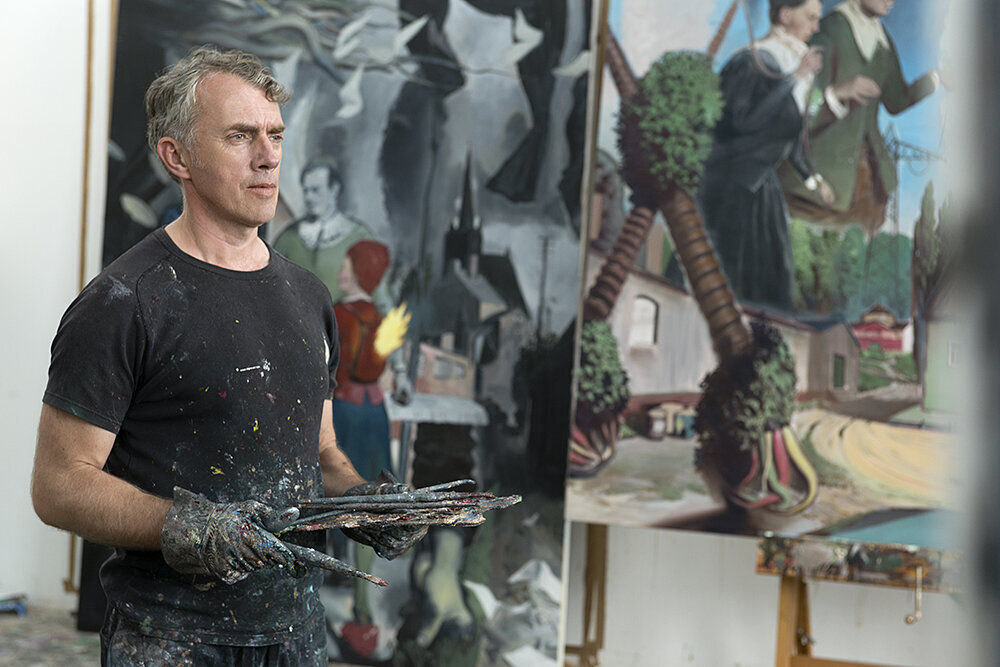
Although I published several academic studies and reviews on art – especially my paper on Neo Rauch* which was published in Germany and is widely cited – see below – I wanted to have an experiential knowledge of painting. I couldn’t see how to understand it if you had never done it.
In 2014 and 2015 I undertook formal study in the Advanced Diploma in Visual Art at the Nepean Art and Design Centre. I became active in the Blackheath Art Society, exhibiting in the shows there and for three years joining the Committee. I also attended many workshops and training sessions over the years, so writing about art was informed at least to some extent by knowing some of the technicalities, as well as the histories, debates and current art thinking, to a limited extent at least.
I have also written pieces about non-Australian art, including a major paper on Neo Rauch, published in Germany, in German and English. This paper has many many readers in Europe and is available in full at the Academia.edu site, below.
*NEO RAUCH is usually identified with the Leipzig School. Rauch present an astonishing body of semi-realist highly technically detailed large-scale paintings unlike anything else in recent Western art. I have written a long essay on Neo Rauch, published in a book on Collective Creativity, available in English on Academia.com
http:// http://www.academia.edu/986658/Neo_Rauch_post-socialist_vision_collective_memories
Art images are becoming more accessible through projects extending the concept of Wikimedia Commons. The Metropolitan Museum in New York is at the forefront. Thanks to them, users are now free to reproduce quality images of great pantings like this. Sadly this is happening at the very moment when Artificial Intelligence (AI) seems likely to overwhelm all our existing practices and understandings. I will be saying more on generative AI and art in future posts.
All this is by way of introducing the rest of this updated art-writing site, which has been in existence now for several years. Let’s see what comes next! All the new stuff will be in Posts: Comments and Reviews.
 Annette Hamilton Art Writing from Australia