Category Archives: Projects

Memoirs from the Present

[WITH THANKS TO BRANDON TAYLOR]

[I am cross-posting this to my writing site and it is also on Substack. I wrote a much longer piece responding to Brandon Taylor’s MINOR BLACK FIGURES post, but I edited it down and felt better for doing so. My proposed book PARIS VERTIGO, which is part-drafted and much-plotted already, is going to be completely refigured. Also I can see how much of my writing is in one way or another art-writing also, and so is Brandon Taylor’s.]

Brandon Taylor’s just published post Minor Black Figures on his Substack site, Sweater Weather (15th March 2025) is inspirational in so many ways.

I love this piece. It seems like a simple narrative but there is so much deepwork here. He writes about his own writing. He knows his topic. He is trying to write something that doesn’t want to be written. He is in a Citadines apartment in Paris, near Les Halles, all set to direct his errant creativity, until the occurrence of an inexplicable body horror: an eruption, a carbuncle, a papule which swells and grows without explanation on his inner thigh. He describes his confusion, trying to seeking medical care in a place where you don’t have the normal supports. You can feel his rising anxiety as the Thing throbs and expands until it bursts in a surge of blood and pain. And pus no doubt.

It was 2023. He was trying to finish a novel which he had been writing and rewriting, each time reaching a certain length (137 pages) until he had to throw it away and start again. Only after his grisly wound was drained was he able to return to his writing which suddenly became something different. His novel, Minor Black Figures, emerged,due to be published in October 2025.

I spent six weeks in Paris in 2024, staying in an old rental apartment. The entire city was going mad in preparations for the Olympics. I was working on a half-drafted novel, a kind of auto-fiction about my experiences in Paris in the early 1980s. It was about woman stuff and the post 70s painting scene and the rise of anti-theory and the “New Philosophers”. But I was too sick to write it, or it was making me sick. I was dizzy all the time and felt constantly confused. I couldn’t manage the stairs and corridors of the metro. The book I had planned refused to co-operate. Too many characters appeared and kept on doing contemporary things, like try to work out how to buy a travel pass from a digital dispenser in an apparently abandoned metro station. Instead of writing my novel I had a major panic attack in Le Petit Palais, a glorious art gallery full of lesser known paintings from the past three centuries.

Le Petit Palais, art gallery extraordinaire. Paris 2024.

There were endless corridors of incredible old paintings. This was one of my favourites. I stood in front of it, wondering at how in the 17th century a virtually unknown painter had produced this picture from his own imagination (since there were no photographs then, remember, no image libraries, no Pixabay) and here it was four centuries later in Paris and so was I, and I couldn’t step away from it.
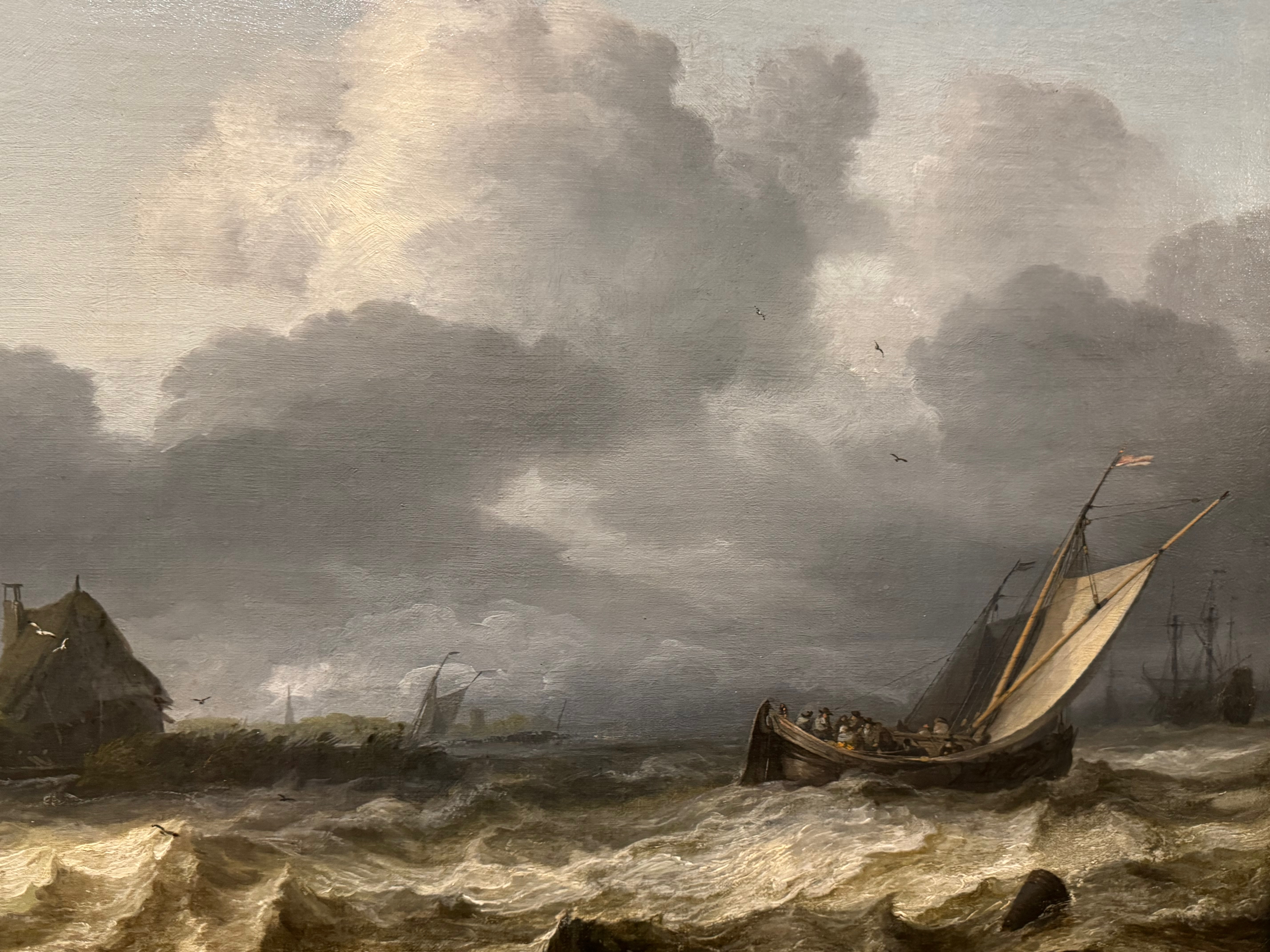
Allaert van Everdingen. L’Orage (The Storm): oil on linen, 1650.

But suddenly I knew I had to lie down, and there is nowhere to do that in Le Petit Palais. I  started to panic. My partner shepherded me around with rising anxiety. I said we had to leave at once. Outside, a set of metal barriers had appeared and no vehicles were allowed to stop in front of the building, or anywhere near it. Police were patrolling up and down. Where to go? What to do? I panicked even more. After what seemed like hours we managed to get back to the apartment. I decided I had to just stay home for a while and not go near that book I had come here to write.

It definitely did not want to be written.  It was full of my usual preoccupations about mothers and daughters and trauma and inter-generational rivalries. After a time I decided I had to find a doctor.  It was so easy! An amazing midnight home visit by a local doctor provided a diagnosis of a mystery virus and consequent high blood pressure. He gave me a script for some magic pills which were procured next morning from the Green Cross pharmacy across the square. I felt better but still couldn’t write anything other than my diary.

After that, I went back to Sydney and thought maybe my book should be about having a panic attack in Paris. It could still be about that early 1980s era, but instead of a “normal” novel it would be a memoir of the present superimposed on a certain past which may, or may not, have existed in its recollected form. I realised I could salvage my original title, Paris Vertigo, which was perfect for this purpose. It could be any length: a Substack piece, a novella, a novelistic memoir. Not a poem, though.

It would probably push aside my daily diary writing, which in any case is no longer daily, and never has anything very interesting in it because I never have time to write it properly. I am so over-committed. So why not add one more probably unachievable task? Brandon Taylor’s Paris story inspired me to think it might be possible.

BELOW: The lobby of the Hotel de Nice, where part of the story of PARIS VERTIGO takes place.

“OBLIVION”: on choosing Arthur Streeton’s painting as my emblem on Substack art-writing site: FUGITIVE REGARD.

I have just set up my new Substack page: please visit and subscribe, it is free, there is no paywall and it is available for comments or discussions either on the post or in the pages.

https://hamiltonartwriting.substack.com/about

I have chosen this painting as the emblem for the site .

The painting is held in a private collection. Oil on canvas 56.2 x 100.5 cm. c. 1892.

Best known for his vivid landscape paintings especially images in and around Sydney Harbour, Streeton was also a skilled genre artist. The painting above seems to have disappeared from public recognition, as it does not conform to the normative narrative about Streeton’s paintings. The way paintings exist in the public sphere, and then disappear from it, is one means by which art can become fugitive. Artists also think about fugitive colors, a well-established problem in oil-painting. Many well-loved colors used by artists over the years are fugitive: that is, they appear rich and strong when first painted, but over time and in unstable conditions they can lose definition and fade away.

Much art-writing is like this: our responses to art change so much, both personally and in terms of the Zeitgeist. A new generation is re-discovering forgotten art, sometimes bringing back genres and styles long considered old-fashioned and discredited. Here is a place for people who love and appreciate painting, who engage with art history and think about technique, to express their understandings. Neglected artists and art-styles, the commercial practice and presentation of art, appreciation and critique find a home here.

My Substack site is dedicated to recovering the fugitive in art, revealing the obscured, refinding the rejected and appreciating some of the strands of thought, mind and materiality which go to make up the world of painting.

What is Art? Thoughts on bodies and animals.

The making of marks and images is embedded in human life.  From the blown ochres outlining handprints on cave walls to the ceilings in Renaissance palaces to the production of every form of visual material in today’s world productivity seems never to have faltered. Some of the most extraordinary art is made using the human body itself as canvas. Before modernity, in hunter-gatherer/horticultural societies, the artistic impulse seems already to have reached its full potential.  Without modern technologies, artists (almost everyone) understood how to obtain natural sources of colour (ochres, pipeclay, charcoals, earths) and how to use different media to mix and fix them to the body, to walls and onto the ground.  Although designs were usually inherited and traditional there was always room for innovation.  This is art in its purest, cleanest sense.  It has no environmental negatives and links the natural and bodily worlds in the deepest way.

Is art-making exclusively human? Do animals make art?  There are some amazing examples, although they seem to be limited to very specific circumstances.  [accessed 7/2/14]

http://www.ucl.ac.uk/news/news-articles/January2012/270112-art-by-animals

http://www.kshb.com/dpp/lifestyle/pets/Kansas-City-Zoo-animals-bust-out-their-paint-brushes

Art, its existence and practice, raises complex philosophical and psychological questions.  Freud and post-Freudian theorists have proposed theories about art and its meanings which are not widely known, let alone accepted, in the art world.  The political meaning and function of art has received more attention.  The changes in the significance and function of art in era of technological modernity (and near universal commercialisation) are closely related to this question, under the influence of Walter Benjamin and Theodor Adorno.  Many resist any attempts to traverse these fields and assess their implications.  Meta-theory is not necessary for the practice of art which always transcends philosophy.  But for anyone trying to practice art under contemporary conditions it can offer stimulus and insight.

One of the most fascinating aspects of the human commitment to art-making is how absolutely useless it is.  There is nothing to be gained from it in terms of the usual requirements for survival: it can’t be eaten, built with, or made to do anything other than to signify and please. Yet the desire for aesthetic pleasure seems embedded and the ability to respond to it seems part of the cognitive system.  Wherever it is possible to decorate something people will do it.  Making a basket to carry produce doesn’t require the intricate modes of weaving which so often appear, but there they are.  As soon as survival is assured and people can live somewhere above a bare subsistence, art-making appears.

Today’s systems of production mean that images are everywhere so nobody needs to feel obliged to make them in order to experience them.  Many feel they can take art or leave it.  But for others, it is something they are simply drawn to.  There are all kinds of art-making, some recognised and rewarded far more than others, but for art-makers one or more forms of expression seem to be pulling at the heart, or maybe the soul, with so much power that it can’t be resisted.

Art-making is a challenge as well as an intensely gripping activity.  I often feel the paintings I want to work on are actively demanding my attention, as if they already exist somewhere and are revealing themselves through me.  My ability to respond is limited by my inadequate technical understanding and lack of training.  Being able to make better art will meet the desires of my conscious, and unconscious, life process.