Christian Boltanski: Chance

CHRISTIAN BOLTANSKI: CHANCE

 cover1

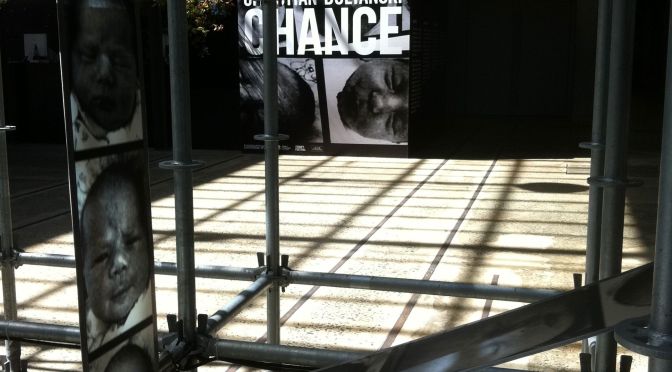
Christian Boltanski’s art patrols the borders of an existential philosophy exploring randomness, memory and death. He works through large-scale installations which have been seen at many prestigious art events around the world, including at the Musée d’art moderne de la ville de Paris,  Künstalle Wien, Museum of Contemporary Art Chicago and many others. The installation Chance, consisting of three elements, Wheel of Fortune, Last News from Humans and Be New (2011) was presented at the French Pavilion at the Viennale, and later shown in Rotterdam, The Netherlands, and in Brazil before its presentation at Carriageworks as part of the Sydney Festival (Carriageworks 2014).

Boltanski left formal education at the age of 12, seemingly suffering from something like autism. Self-taught, he began painting in 1958 when he was fourteen years old.  He came to public attention in the late 1960s with a series of short avant-garde films and the publication of notebooks in which he reflected on his childhood. All of this work combined reality and fiction, offering doubtful evidence about his own and other people’s existence.[1] In the 1970s he turned to photography using objets trouvés as subjects. Then he began creating marionette-like figures from cardboard and scraps, transposed into large picture formats. Mysterious shapes of silhouettes in movement emerged (Fox 1998).

But the kind of work for which he is best known emerged in the mid 1980s when he began making installations from different materials and media. His installations rely on the ephemera and off-casts of human experience.  He has used obituary photographs, lost property, and forms of memorialisation of unknown people. In one work he used portrait photographs of Jewish schoolchildren taken in Vienna in 1931 as a reminder of the mass murder of Jews by the Nazis.  In another he filled rooms and corridors with items of worn clothing as a reminder of the clothing depots at concentration camps.   Objects were used as testimony to human experience and suffering (Franzke, n.d.).

Contemporary trauma theory would suggest that he, like many other artists, was using his art to “work through” some specific elements in his personal biography.

Melvyn Bragg, in the video interview directed by Gerald Fox (1998) repeatedly attempts to return to the idea of a traumatic kernel at the centre of Boltanski’s art, something located in his own biography.  He was born in Paris in 1944. The war in Europe was almost over by that time.  The events of the war, the persecution of the Jews, the realities of the concentration and extermination camps, would have long ended by the time he became old enough to be aware of social and political matters. His work on themes related to extremity, memory, suffering and chance seems to have this origin but apart from brief comments in interviews it is difficult to be sure of “the facts”. Even the text often referred to as his “memoir” (Boltanski and Grenier 2009) is entitled “The Possible Life…”  which leaves its basis open to interpretation.[2] Nevertheless something in the conditions of his childhood similarly influenced his brother, about whom he hardly ever speaks.[3]

His brother, Luc Boltanski, is an eminent Professor of Sociology in France’s most prestigious Insitute of social sciences, the École des hautes études  en sciences sociales, in Paris, and is the leader of a new “pragmatic” school of French sociology, known for its political and moral framework. His work lies broadly in the field of biopolitics.  In his book Distant Suffering: Morality, Media and Politics hedescribes a politics of pity based on the spectacle of suffering.  Viewing by the fortunate who do not share the suffering of those they observe is the basis of this politics.  Mass media in particular television has spread this mode of perception and public reaction to the rush of uncontrolled events in reality.

Victimhood provides a particular identity and the politics of pity demands that the observers find a way to urgently assist them.  This is not a matter of formal justice: there can be no question of who is “at fault”, merely a recognition that those who suffer must be assisted. “The development of a politics of pity thus assumes two classes which are not unequal by reference to merit … but solely be reference to luck” (L. Boltanski, 1999: 5). It is hard to avoid the conclusion that the works of both brothers may arise from a common strand.

C. Boltanski likes to present himself as trangressive or even shocking. In the 1980s he spoke of the artist’s life as like a Hasidic tale or a Zen story.  He claimed that artists are like saints who live in the desert on top of columns, but at the same time are crooks. He wants to make a moral work, speaking of universal things, life and death, being and not being. He claims he, and other artists, are like preachers, believing in their art and yet being somehow false. Works of art are like relics, he says, and the more you create, the more you disappear and so you are in a way invisible or dead.  This article is extremely revealing regarding his philosophy at that period, with useful comments on the relation between his work and the Holocaust, especially on the large piece The Children of Dijon (Borger 1988/89, p. 24).

Impermanence, transience, and loss is reflected in the works themselves, which cannot be “collected” in any conventional sense.  The vast installations are destroyed after exhibition. This highlights one of the most puzzling questions about artists like Boltanski. Their work is entirely conceptual. They do not “make” their art. All of their exhibits have to be constructed and managed by others. In what sense is the creator an “artist”? Can art be separated from the physical action of its creator?  Does the contemporary, or perhaps it is post-modern, obsession with conceptual art and installation arise from an ethical insistence on the priority of idea over form and of collective effort above private individual labour?

There have been other, deeper, critiques of Boltanski’s oevre. For example some have questioned the ethics of his position.  He seems to apply an almost complete lack of differentiation between individuals and types or groups of people.  This is very evident in Chance.
faces newImage


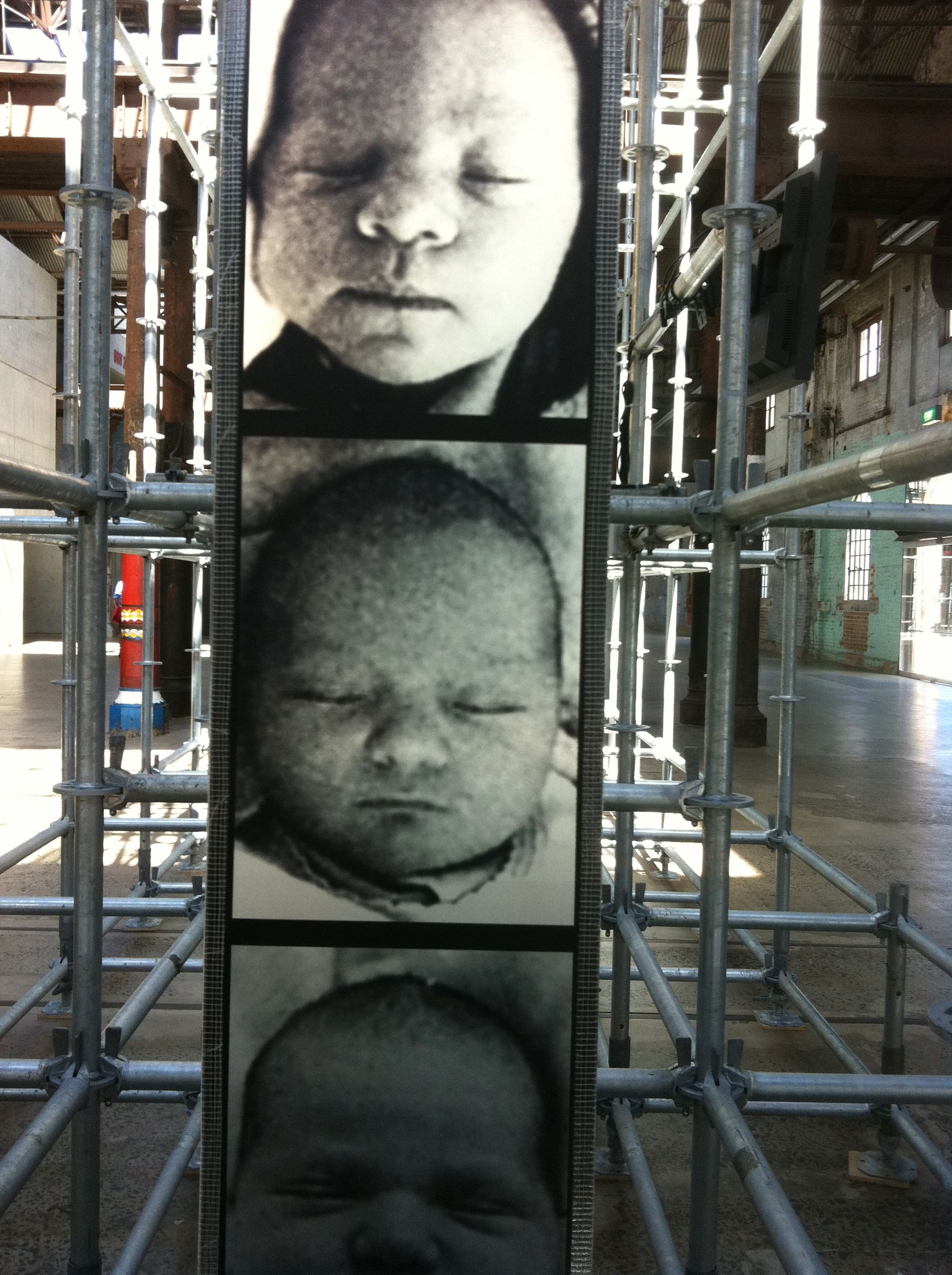
The Polish newborns are located within a “space” –  Poland – but out of time. They might have been born in the 2000s or for that matter in the 1940s.  Their fates of course would be totally different, and this is the central point Boltanski is trying to make. His modes of representation do not distinguish between the origins and consequences of the operation of random fate. In another work, Les Archives: Detective (1987) he drew no distinction between victims or murderers. As Solomon-Godeau suggests, “it implies a bottom line equivalency from which ethical distinctions are banished. This means we are unable to cast judgment on those represented.” (2012: 8).  A counter-argument could be offered: that there should be a basic equivalent respect for all individuals, regardless of their deeds. This seems a view quite consonant with much contemporary ethical philosophy, which undermines the traditional expectation of ethical judgments arising from collectively recognised justice and morality. It is a form of postmodern relativism in the field of ethics.

Other critics express disgust with Boltanski as one among many others whose fundamental preoccupation is with an empty euphoric-apocalyptic hysteria disguised as a form of politics. Charlesworth, for example, says:

But it’s everywhere — from Allora & Calzadilla’s United States of Self-loathing, to Mike Nelson’s anxious simulation of an alien  Middle East, to Christian Boltanski’s crazed machine of speeding overpopulation — the nervous breakdown of a politics of crisis suffuses every pavilion. It’s like being in a room full of manic-depressives who haven’t had their meds, all sobbing and               babbling. (Charlesworth 2012, p. 56)

While this is over-stating the case, there is nonetheless a certain force to this view, raising questions about the forms of political engagement possible for the contemporary artist.

“Chance” at Carriageworks 

skylights

It is a warm humid day in Sydney. The sun streams down from a vivid blue sky.

Carriageworks offers an amazing visual space.  Its vastness and clear panels of roofing create a mobile tableau of lights and darks. The walls have been preserved, or rather paused in their process of decay.  Rust gathers along the chrome yellow girders, No L 64, high above the floor level, announces LOADING TO EXCEED 10 TONS.  This girder, its depth and solidity, anchors one end of the building. Two smart-looking fellows are perched at tables, staring at computer screens.  Cutlery gleams inside shiny tin cans.  The napkins are made of brown heavy paper. Light illuminates brick-red pipes which support interior lights.

girders1

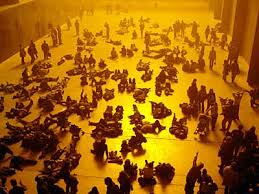
Boltanski’s gigantic work Wheel of Fortune is easily contained here. Sunlight illuminates the bright silver scaffolding, eight metres high, weighing twenty tons. Its intricate assembly creates a layered perspective through which the endless line of enlarged black and white images of newborn baby faces pass.  They move at a steady pace, until a bell rings and the loop of grainy images comes to a halt, the camera capturing one child’s face which is displayed on a screen.

heads reverse

These are photos of newborn babies, taken from the birth announcements of Polish newspapers.  They could be from any age, any place.  Seeing them at the far end of the installation, they are now reversed.  It makes no difference. The intent behind the display is simple: all people are the product of a chance moment, of the specific moment when their parents made love; had it been before then, or afterwards, each person would have been different.  A technical and temporal flash creates us all in our apparent difference and uniqueness.

An employee has to be present at all times to make sure that the machinery governing the movement of images through the vast scaffolding is not interrupted by some mechanical failure. When after the first installation it proved too hot for the glue holding the screen of images together it was necessary to find skilled artisans with large machines able to sew the canvas materials on which the images were printed together (personal communication, staff member, February 2014).

faces1


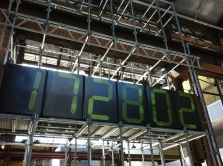
At each end of the piece, the second element of the exhibit is located high above the heads of the viewers. Last News from Humans displays two digital tallies in real time showing births and deaths around the globe.  The yellow/green shows the number of births, the red the number of deaths. Through the flashing lights we see how quickly lives are created and end.
green nos red nos

It’s sobering to consider the discrepancy between the numbers being born and the numbers dying. At the time of my viewing, 176,000 were born and a mere 66,000 died – or had died at some specific time, although this was not well explained.  My immediate thought:  more people should die. I mention this to the young man overseeing the operation of the machinery.  He seems shocked.  We are supposed to think that fewer people should be born.  There are deep existential and philosophical issues here.

To one side is the third part of the exhibit, Be New. This consists of three disparate photographic sequences, images of the Polish newborns intercut with images of deceased elderly Swiss people.  The latter images came from another Boltanski installation. There are potentially 1.5 million combinations from the three segments.  The viewer presses a button and produces a new human face. This is meant to remind us that we are all composites of our ancestors.


I get this exhibit, in a way I hadn’t expected.  It is disturbing and beautiful at the same time.  But it is also quite banal.  It looks “lovely” in this space, but that’s largely due to the space itself.  The aesthetic pleasure offered by the walls is stunning.

wall1


Cross-hatched concrete fills in corners; white brick is rubbed back and scrabbled over with dirt and rust. This is a real monument to generations past – to a lost way of life, a time when human labour alone created spaces like this with real human muscles, sweat, blood and optimism. The net of connections across the state of NSW depended on this place, without it there would have been no railways. I find this thought far more compelling than pondering Boltanski’s anonymous Polish babies.

His sensibility is that of old Europe. There is a place for that, and we should be reminded.  But we are in the south, the humid air of the Pacific washes through the doors, the sun shines. There are definitely too many people in the world, and yes, chance seems to allocate some to here and some to there, a process which is truly “random”.  It is true we would be different – a bit different – if our parents had carried out the reproductive act at a different moment.  Would that matter?  Larger, more urgent, questions seem occluded or disguised by this seemingly philosophical work.  The focus on the individual – on the idea of being “somebody” – pushes the broader historical and political issues aside.  Boltanski’s entire oeuvre has been obsessed with memory and the traumatic residues of twentieth century history. Questions of human existence explored through a post-Holocaust aesthetics may seem at one level to be an ethical stance, but where can it go from here?  Boltanski’s installation is surprising and strangely beautiful, but it made me think far more about why we have no properly functioning railways any more, a question of huge political and ecological significance for the future of this beautiful land, which could provide the basis for a more relevant work of art. This calls for a form of ethical judgment which takes into account the broader role of art. As Nowak comments:

…judgment in general should be understood as intrinsic to the task of art criticism. I argue that judgment is under-theorized in contemporary visual art critical circles and that the ethical judgment of art is of particular importance. My position is something of a departure from dominant understandings of judgment in these circles, for since the end of modernism, judgment (of whatever type) has been widely held to be either outmoded or inappropriate. (Nowak, 2012, p. 8).

Work such as Boltanski’s pushes the viewer directly into a world where judgment is invoked and ethical perspectives are invited.  For this we should be grateful, while recognising that there are historical and cultural factors requiring urgent consideration of the role and value of art today.

References

Boltanski, Christian with Catherine Grenier, 2009.  The Possible Life of Christian Boltanski. 1st ed. US: MFA Publications.

Boltanski, Luc, 1999. Distant Suffering: Morality, Media and Politics.  1st ed. New York: Cambridge University press. First published as La Souffrance a Distance, 1993, Paris: Editions Metaille)

Boltanski, Luc with Chiapello (Ève), 2005. The New Spirit of Capitalism, London/New York, Verso.

Boltanksi, Luc. 2011. Une étude en noir. Tracés. Review des Sciences Humaines, 20, 2011.  On Line 16 May 2013. http://traces.revues.org/5049. [Accessed 1st March 2014].

Borger, Irene and Christian Boltanski. 1988/1989. Interview.  Bomb, 26, 22-27.

Charlesworth, J. J., 2012.  Boltanski. Art Review, 56, 52.

Fox, Gerald (Dir). 1988. An Exploration of Art on Film.  English, Pal, VHS.

Franzke, A. n.d. Christian Boltanski. Artist biography. Tate Modern.

http://www.tate.org.uk/art/artists/christian-boltanski-2305

[Accessed 15 Feb 2014].

Nowak, Jolanta, 2012. Judgment, Justice and Art Criticism. Contemporary Aesthetics,10, 8.

Solomon-Godeau, Abigail, 1998. Mourning or Melancholia: Christian Boltanski’s Missing House. Oxford Art Journal,21, 2, 20.

 Catalogue Essays:

Christian Boltanksi, 1978. Reconstitution. Exhibition Catalogue, ed. A. Franzke and M. Schwarz, Karlsuhe, Bad. Kstver.

Christian Boltanksi, 1984. Exhibition Catalogue, Ed. B. Blistene, Paris, Pompidou,

Christian Boltanski: Lessons of Darkness, 1985.  Exhibition Catalogue, Ed. L. Gumpert and M. J. Jacob; Chicago Ill: Museum of Contemporary Art.

Photographs: All photographs taken by Annette Hamilton at Carriageworks February 2014 unless otherwise credited.

[1]  The casting of doubt in artistic works is highly characteristic of many forms of art in the late twentieth century, often with reference to the Holocaust and its aftermath.  In literature an outstanding example is the long writing – novel, memoir, fantasy? – Austerlitz, by W. G. Sebald (2001).  In Austerlitz, Sebald not only writes about somebody who might or might not exist telling the story of someone else who might or might not exist, he presents series of photographs which the reader is invited to take as visual evidence of the “truth” of his narrative, even though the source of the photographs is unacknowledged. This profound unsettling of the boundaries between “truth” and its representation is very evident in Boltanski’s work, as is clearly evident in his strange insistence on obscuring his own identity and taking on guises such as “the Preacher”.

[2] This tendency to self-mystification, or at least to obscuring elements of biography, contrasts with the usual pattern of self-disclosure common among fiction writers and poets.  The insistence by “the public” on knowing everything about their artistic heroes does not recognise the legitimacy of such distinctions.

[3] His self-construction wavers but he often claims the conditions of Nazi occupation in Paris as a source of his artistic themes. In conversation with David Walsh, owner of Museum of Contemporary art in Tasmania, he spoke of himself as “a sort of survivor”.  He describes how his Catholic mother hid his Jewish father under the floorboards although this feels as if it could be an apocryphal story. See http://www.au.timeout.com/sydney/art/features/12957/christian-boltanski-on-chance
 

Elisabeth Cummings: Slow Art

DSC00206

 [Photograph:  Annette Hamilton 2012]

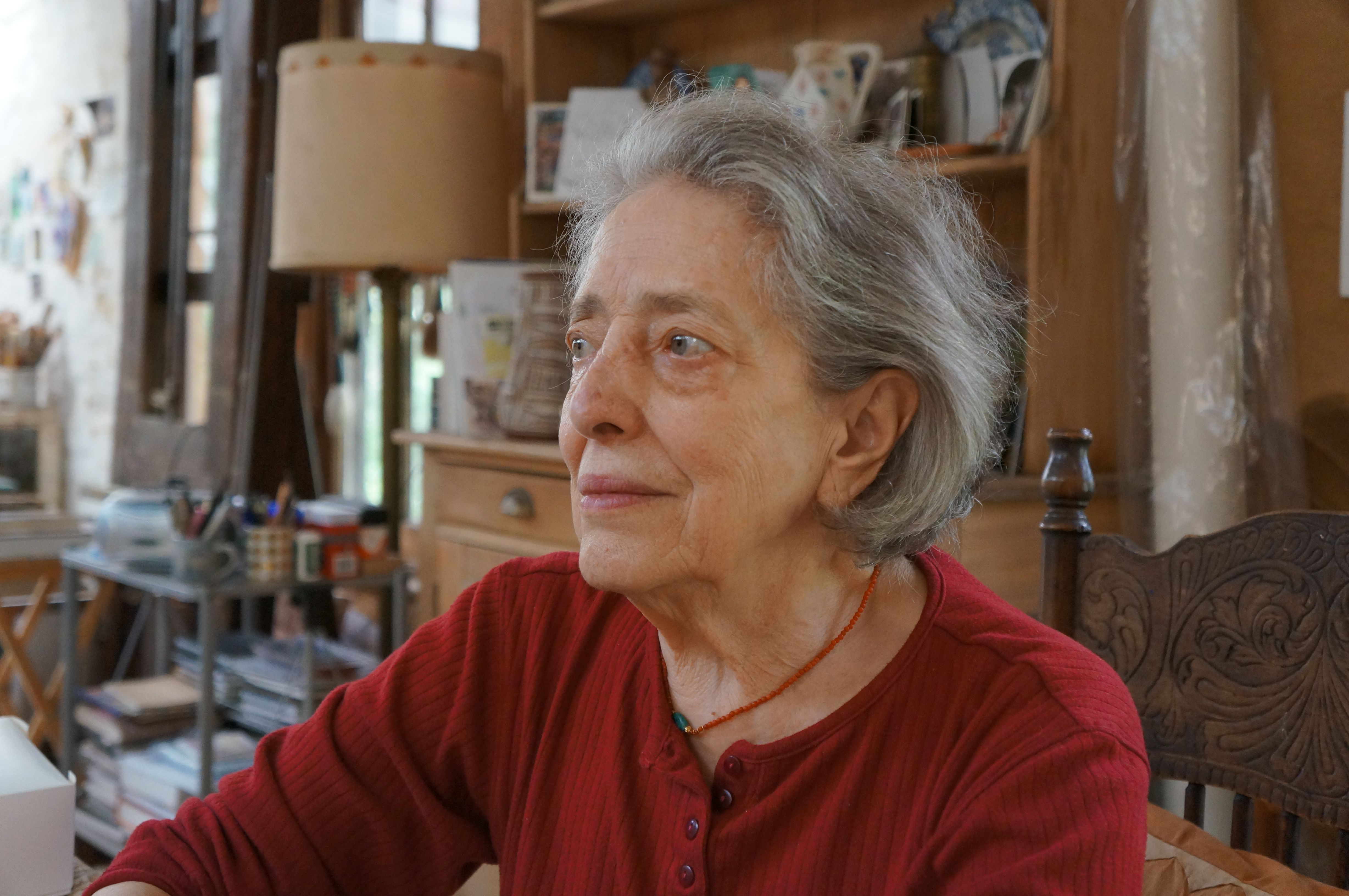
 Elisabeth Cummings (b. 1934) is not well-known among the general art-going public.  She has been devoted to her art practice, mostly painting, for over fifty years.  Few of her works appear in any public gallery collections in Australia.  Based in Sydney and its bushland outskirts, she has travelled and painted in outback towns and in remote Western and Southern Australia.  In 1996 she was given a survey exhibition by the Campbelltown City Bicentennial Art Gallery, but at that time she had only one painting in the collection of the Art Gallery of NSW, while one work in the National Gallery of Australia had been transferred to Artbank. Nothing had changed six years later.  Recently her work has been receiving more recognition.  Several smaller public collections hold paintings, and she is increasingly sought by avid collectors. She has won a number of prizes, and recognition of her importance as an Australian landscape painter has grown.  The 2002 Art Collector Magazine list placed her in the 50 most collectible Australian artists.

In 2012 she received a major survey exhibition at the S. H. Ervin Gallery titled Luminous: The Landscapes of Elisabeth Cummings.  One of her largest works, Edge of the Simpson Desert, was a highlight of the show.

 Image

Edge of the Simpson Desert, 2011.  Oil on canvas, 175 x 301 Private Collection

 This is hardly conventional landscape art.  It is edgy, figurative only in places, filled with spaces and lines which demand patient scrutiny before the forms reveal themselves. It is something like Slow Food.  Hers is a slow art: slow to be painted, and calling for close engagement and patient appreciation from the viewer.  She works with the local, and paints where she is.  Whether travelling through the remote deserts or sitting on her verandah in her studio at Wedderburn, or inside with the light pouring on the mud-brick walls, her faithful black dog at her feet, Cummings is resolutely there in the moment.

Image

Inside the Studio.  Photograph: Annette Hamilton 2012

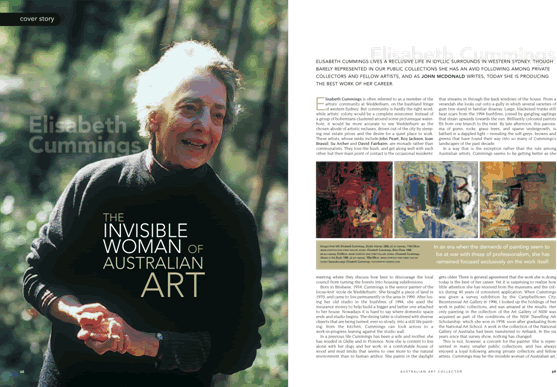
 She has been called The Invisible Woman of Australian Art (Frost 2002).  But she doesn’t really care about visibility, or profile, or her “career”.  Now in her late seventies, she continues to work and live as she has always done.  She paints, and teaches these days in the occasional workshop (see for example Champion 2012).  She hates being interviewed especially about her personal life.  One journalist from the Sydney Morning Herald insisted on an interview while she was confined to a wheelchair following an operation on her right ankle. He tried to force her to reveal elements of her emotional life, on the grounds that this is  “the fundamental raison d’etre of any artist”. She found this an absurd proposition, and managed to be so unpleasant to him that he left with his irrelevant curiosity unsatisfied (personal communication, and see Meacham 2012).  Cummings is the last person to want to be a celebrity, although she has many close friends in the art world and always has invitations and events to participate in, if she wants to.  But she likes a quiet life, and loves her “bit of bush”, even while mourning the fact that it is being encroached on by the endless march of suburbia.

Image

Sydney Morning Herald art critic John McDonald has been one of the few vocal supporters.  In Art Essays, January 21 2012, he pleaded that a new show from the National Gallery of Australia of landscapes to be held at the Royal Academy London should include those artists who are making an outstanding contribution to Australian landscape art today, the foremost of whom is Cummings.  He deplores the short-sightedness of Australian public collections.

“While galleries have been queuing up to buy works by a handful of fashionable artists, they have treated landscape painting as if it were a purely historical phenomenon.” (McDonald 2012)

Cummings herself has nothing to say about the “fashionable” contemporary arts. Her positive frame of mind does not dwell on endless comparisons or bother to condemn the fetishization of certain forms of current art-making and the implicit rejection of the unfashionable genres.

An excellent video interview in Wedderburn, with Peter Pinson, puts a frame around many elements of her life and art (Pinson 2012).  Her father was an architect (as is her son now) and her family supported her interest in art as a profession – unusual for a woman in those days.  She attended the National Art School in Sydney, and won a Travelling Scholarship in 1958 which allowed her to spend time in Europe, staying in a villa with friends near Florence.  In 1961 she studied under Oskar Kokoschka, a late German expressionist associated with Egon Schiele and Gustav Klimt.  Kokoschka established his “School of Seeing” at the Internationale Sommerakademie für Bildende Kunst in Salzburg, thus re-establishing his ties with the Austrian milieu in which he began his career, and Cummings was able to spend time there exploring the highly distinctive, and disturbing, post war European sensibility.

Image

Oskar Kokoschka.  Bodegon with Affair and Rabbit.  161 x 118.  1914.   www.wikipaintings.org

Cummings is often referred to as “reclusive” (Frost 2002).  Her Wedderburn studio is the site of an artists’ community established in the early 1970s.  Two of its founders died in 2013, Roy Jackson of cancer in July,  John Peart in October, a sudden and wholly unexpected death at the age of only 67. Other artists who have worked and lived there include Joan Brassil, Sy Archer and David Fairbairn.  A strong community living on land donated by art lovers Barbara and Nick Romalis in the 1970s, the Wedderburn artists’ “colony” continues to offer a refuge and resource almost unique in contemporary Australia.

In the bushfires of 1994 Cummings lost her studio, a blow which might have stopped a lesser person.  But she soon built a bigger and better structure which served as both studio and home.  The house and bushland around often apear in her work,  as though the whole life-space is part of a continuous still-life.

Her large oils are notable for their heavily worked surfaces and colouring surprises.  They offer secrets:  spend enough time with them, and there is the reveal. The forms of the natural world appear through the scraping and marks on her surfaces.  Her palettes seem tasty.  Some, especially those reflecting the bushland around Wedderburn, are full of delicious soft pales and shadowy greens and browns. Others, in remote and outback places, are bright and hot, like a hit of chili and vinegar.

She isn’t immediate, or obvious.  Comparing her visual impact with another little known but successful Australian landscape painter, Jason Benjamin, we see two aspects of the Australian heritage.

Image

Jason Benjamin.  This is Love.  Oil, 434 x 291.  www. Artistsandart.org

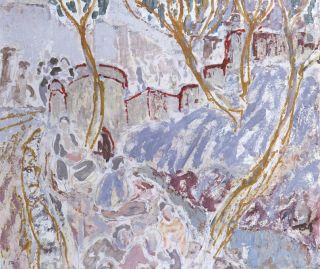
Benjamin works on a vast scale with immediately recognisable subjects, in a style securely located in European classicism (albeit with a strange surrealist quality).  Cummings, on the other hand, hovers between the gestural demands of post-war European modernism and the meditative mysteries of the Australian vision imprinted with an Asian sensibility.  There is Ian Fairweather in her slippery calligraphic marks, and Fred Williams in her itchy surfaces.

Image

Ian Fairweather.  Outside the Walls of Peking, 1935.  Oil and pencil on board, 49 x 57 cm.  Private collection, Perth.

Cummings has long been represented by King Street Galleries, now in William Street Sydney.  She feels strong loyalty to the gallery, which has supported her work with well-mounted shows for decades (personal communication, February 2012). She has exhibited in some competitions and group shows, but most of her professional output has been sold through the gallery. Current listings at King Street have some of her recent works available, for instance Sir John Gorge Mornington, 2013, oil on canvas, 135 x 150;  $48,000.  The recent oils are quiet reflections on landscapes visited in the past.  A beautifully delicate work, The Pink Outcrop, 213, 105 x 130, presents a lyrical pastel shaded landscape, tender and responsive.  It sold for $35,000.
Image

Photograph: King Street Galleries.

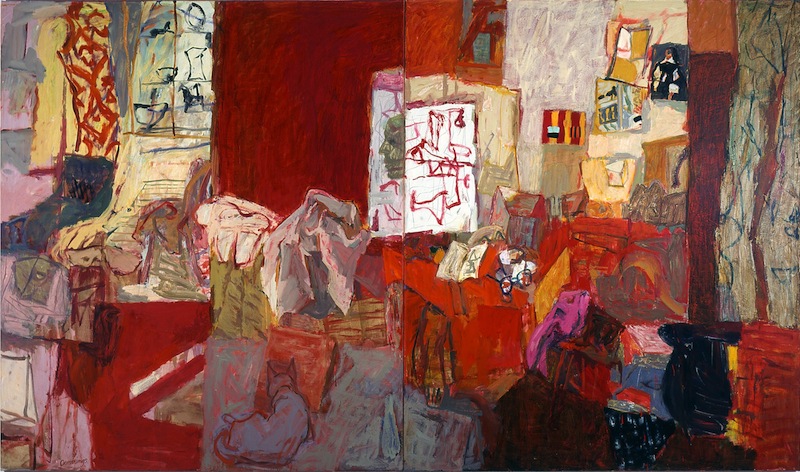
Her works from the middle 2000s show a strong sense of line and composition.  Studio in the Bush (2006), 115 c 130, is a striking work based on her perception of the context of her life-space at Wedderburn. Journey Through the Studio (2004), 150 x 300, likewise offers a stunning meditation on the process of inhabiting the artist’s world, with its red and orange cadmium hues, the outline painting of a dog in the foreground, and the heavy dark wood-stove at the lower right.  A strangely disturbing painting, it repays long scrutiny and engagement.

Image

Journey Through the Studio (2004), 150 x 300. Photograph:  King Street Gallery

Cummings also works in prints and etchings.  Her 2009 Hill End Glimpses is an artful tracery with several images seemingly hidden in the surface busyness.  A woman stands, washing her hair.  Two dogs trot along in the foreground.  A large bird perches on a fence.  Another woman lies reclining, perhaps in her sleeping bag.  The square dark building with its enigmatic figure at the opening could be anything: a shed, or a house, or a storeroom.  These are the painters, on their plein air excursion, taking the measure of the town of Hill End, made famous by the paintings of Russell Drysdale, John Olsen and others (see Australian Government, Hill End painters, n.d).

Image

Hill End Glimpses. 2009. Etching, set of 25.  Image: King Street Gallery.

Arkaroola Landscape (coloured etching, 2005) uses a limited, traditional desert yellow to great effect. This remarkable piece was not hung in the Wynne Prize to which it was submitted that year, but towered over the other works in the Salon des Réfusés (McDonald 2012). Flinder’s Farm depicts the overwhelming quality of the semi-desert landscape and the futility of human efforts to farm there.

Image

Flinder’s Farm.  Coloured Etching 2009.  Photograph: King Street Galleries

 She speaks more about her etching and print-making in an interview, during a residency at COFA and work with Cicada Press (Butler, 2012).

She is always seeking new inspiration.  Recently she has spent periods in India, working with children in a remote village, offering informal art training.  She seems to accept no limitations: age, physical health, the effects of arthritis, the death of her close friends – she dwells in an intensely felt but manageable world, living through her own time and in her own places, which you can share through her art, if you so choose.  What a privilege that is.

Image

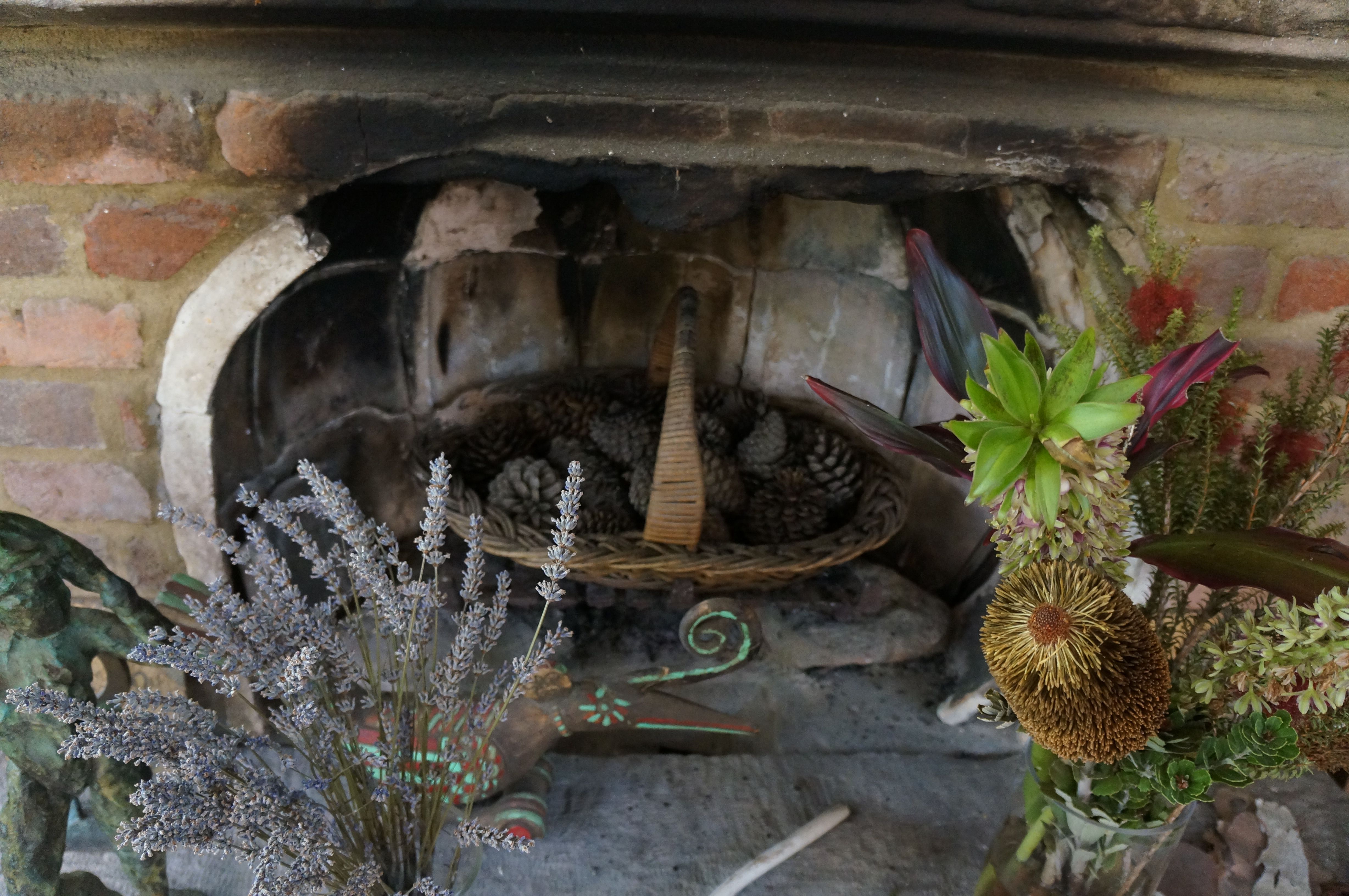
Real Still Life in the Studio.  Photograph: Annette Hamilton 2012.


References

Australian Government.  Australian Stories.  Hill End painters – Donald Friend, Russell Drysdale, John Olsen, Margaret Olley and their legacy.

http://australia.gov.au/about-australia/australian-story/hill-end-painters

[Accessed 22nd February 2014].

Butler, Angela.  Interview: Elisabeth Cummings. November 27, 2012.

http://cicadapress.wordpress.com/2012/11/27/interview-elisabeth-cummings/

Champion, Stephanie.  Pushing the boundaries with Elisabeth Cummings. http://www.bluebanksia.com/artworkshop-reviews/168-review-elisabeth-cummings.html) [Accessed 22nd February 2014).

Frost, Andrew.  Elisabeth Cummings: The Invisible Woman of Australian Art.  Art Collector.  Issue 22, October-December 2002.

http://www.artcollector.net.au/ElisabethCummingsTheInvisibleWomanofAustralianArt. [Accessed 20 February 2014].

McDonald, John. Elizabeth Cummings. Art Essays, January 21 2012.

http://johnmcdonald.net.au/2012/elisabeth-cummings/#sthash.14IbTk1z.dpuf [Accessed 22 February 2014].

Meachem, Steve.  Landscapes and private views.  Sydney Morning Herald, January 4, 2012.  http://www.smh.com.au/entertainment/art-and-design/landscapes-and-private-views-20120104-1pl1i.html

[Accessed 22nd February 2014).

Pinson, Peter.  Peter Pinson Interviews Elisabeth Cummings. Wedderburn, February 2013. http://www.cultconv.com/Conversations/Cummings_Elisabeth/HTML5/testimonybrowser.html [Accessed 21st February 2014].

The New Shock of the New

THE NEW SHOCK OF THE NEW

robert hughes b and w

Robert Hughes, eminent Sydney-born art critic, published his highly acclaimed book The Shock of the New in 1980. His longstanding position as art critic with TIME magazine gave him unprecedented access to artists around the world.  His criticism was often contentious and he was viewed as a “conservative”, although he had no particular philosophical axes to grind. In this DVD, he offers a revaluation of what has happened to both “shock” and “newness” since that time.  You can view the video at:

http://art.docuwat.ch/videos/the-shock-of-the-new/the-shock-of-the-new-09-the-new-shock-of-the-new/?channel_id=0

Hughes died at age 74 in New York in 2012 after a series of tragic events including a terrible car accident in Western Australia, which resulted in serious injury to Hughes and the three young men in the other car, and a court case.  It seemed Hughes’ position as an expatriate Australian and a high profile intellectual were enough to make the Australian press furious and accusatory. Details about the accident and the case are contained in the interview with Jana Wendt here:

http://sgp1.paddington.ninemsn.com.au/sunday/cover_stories/transcript_1445.asp

No doubt this terrible experience sharpened his perceptions and focussed his mind on issues of Being, life and death, and the moral obligations of the artist.

It is clear from the way this video is constructed, and from many of his interview questions, that he regarded much of the work of the contemporary art world darlings as a degradation of art, aimed at making the artist into a marketable commercial celebrity.  The kind of “shock” the art world produces today is mostly absurd, ugly and pointless, from his point of view.  He gives fascinating examples through interviews with stellar figures in today’s art world – Jeff Koons for one – and then offers examples of contemporary artists who in his view carry on the essential virtues of art.

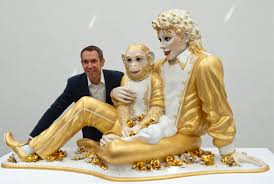
His interview with Jeff Koons is really brilliant.  What comes through so strongly is that Hughes is teasing or sending up Koons,  who, in his well-tailored suit, is so sure of his own significance that he doesn’t realise it.  Hughes draws attention to the fact that Koons regards himself as a direct descendant, or perhaps even reincarnation, of Michelangelo, and looks at his Pieta-like sculpture of Michael Jackson with a very jaundiced eye.  I found this sculpture actually quite fascinating, and not horrible at all, although a lot of Koons’ work does seem to me trite, overblown and ridiculously overvalued.

Jeff Koons Pieta

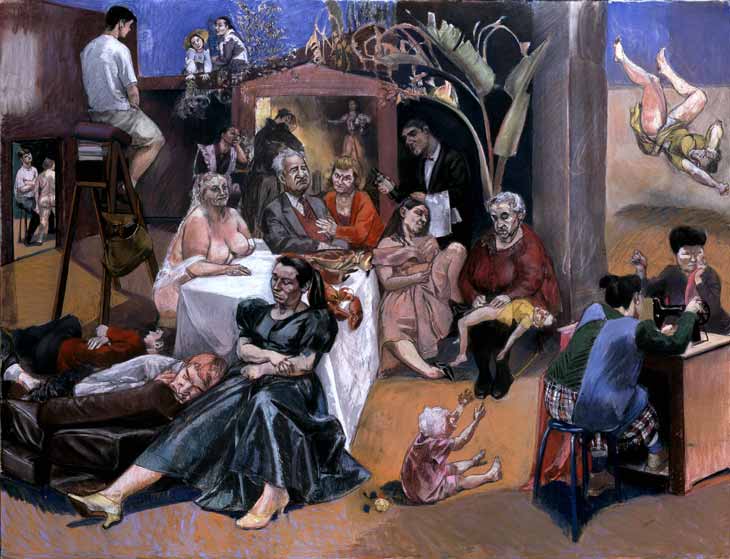
Some of the other artists he considered included the little-known Paula Rego, b. 1935 in Portugal, whose brilliant disturbing images seem rich with narrative and engagement in a scarily familiar universe.  The idea of a “discreet undermining” and the confessional/psychiatric tone of her work opens a different kind of viewing. The violence of folk tales and the terrors of childhood, the truth of families and the fear of never knowing what is under the bed (a pig, in one case!) envelop her works.  Her work is political, traversing the line between private conscience and public responsibility.  Her paintings especially of the 80s and 90s seem to some degree close to Lucien Freud’s, but I see her real affinities to be with the German figurative post-socialist Neo Rauch.  She is a very fine painter technically, her figure work and composition is outstanding.  It is clear why Hughes would want to contrast her with the vapid posturing of the Britpack artists; on any measure she is so much the better artist, yet she has been almost entirely “off the radar”.  Her images are too deep, her vision too disturbing, and she is a figurative painter and a woman.  At least three strikes against her.

Below:  Celestina’s House.  2000-2001.  Pastel on Paper: 200 x 240 cms.  Look closely at the details of this amazing work, go to:  http://www.saatchigallery.com/artists/artpages/rego_paula_celestina_house.htm

celestinas house

Other painters discussed by Hughes included Anselm Kiefer.  Another political artist, it is much clearer to see his politics than in the case of Paula Rego.  One work discussed, Den Goldenen Haar Margarethe, is based on the poem by Paul Celan, Death Fugue,  which includes reflection on the phrase in the poem “Death is a master from Germany”. The inmates of the death camps will rise as smoke and their graves will be in the clouds.  The lines are:

He calls out more sweetly play death death is a master from Germany

he calls out more darkly now stroke your strings then as smoke you will rise into air

then a grave you will have in the clouds there one lies unconfined.

For the full poem, see:

http://www.english.txstate.edu/cohen_p/postmodern/Literature/Celan/Hamburger.html

kiefer-dein-goldenes-haar-margarethe

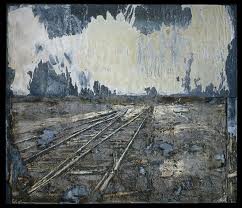
Kiefer’s painted images are dense and complex.  In many of his paintings he seems determined to pull the viewer into the recognition of perspective, even if it is only of railway tracks heading for the death camp, or some empty barracks stretching to the horizon.  Kiefer and Rego represent the need for an art which refutes the sterile irony of contemporary representation and asserts the primacy of a moral imagination.

Kiefer railway

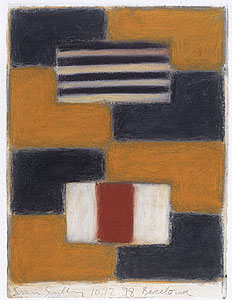
Other better known artists discussed include Lucien Freud and David Hockney. I enjoyed these discussions less than the earlier ones, and felt Hughes himself had been drawn into a kind of hero worship. It was particularly odd to me that he went on to include such a long discussion of Sean Scully.  Scully is an Irish-born New York based printmaker and artist working from a downtown studio.  He has been nominated for the Turner Prize, and has had exhibitions all over the world, including in Australia.  Best known for his huge abstract colour field images he seems to me a kind of overblown Mondrian.  For his exhibition Colour of Light at the National Gallery in Canberra in 2004, he was quoted as saying of his paintings:

There’s a lot of physical force to them, a lot of tactile sexual energy, a lot of sensuality.  But there’s a lot of uncertainty about what the relationship between the parts actually means and I think that that’s a very important aspect of my work. I mean if I have to choose a course between Puritanism and extreme romanticism, I think it’s clear than I’m going to choose extreme romanticism. But I think what I can contribute is something that has both in it, something that has the possibility of both in it, and it’s that extreme stretch that I want to try to achieve in my work. That’s my ambition.

http://nga.gov.au/Exhibition/Scully/Default.cfm

Sean Scully 1

Scully seems to be well-regarded by fellow Irish expatriates and admirers, but the case for his art seems much less strong than that of others in this discussion.  What Hughes liked about it was the sense that it was meditative and contemplative, with its opaque and stone-like surfaces, density and lack of space.  His art looks like architecture, Hughes asserts. Without standing in the same space with these gigantic works, it is almost impossible to grasp them.  Yet, with a Rothko, you can look at almost any reproduction of one of his colour field paintings and feel immediately what it is doing, how it is drawing you in, what it means to think about meditation and contemplation.  To some degree this is true even of the great “black” paintings in the Rothko Chapel, Houston, although to see any image of them is nothing like standing or better still sitting in that mystical space and watching the apparently black surfaces begin to breathe, move and emanate the life force.

Rothko_Chapel_1

Hughes closes his revaluation with some very strange remarks, as if someone scripting his show has insisted that he make some comments on very banal and boring issues.  Can Art create Revolution?  Or just social change?  Is it enough to be “beautiful”?  Do people need beauty?  Are Museums (Art Galleries) the new Cathedrals?  Closing with images of the Weather Project in the Tate Modern, the suggestion that this represents a new Sun God worshipped by art lovers below seemed tacky and almost stupid.

weather project Tate Modern

I felt deeply sorry for Robert Hughes by the end of this show.  One of the greatest art critics of his era, a highly individualistic and sensitive man, Hughes seemed to be struggling against the very forces which he was condemning at the beginning of the film.  It would be so interesting to have a documentary showing the “behind the scenes” of the making of the New Shock of the New.  It might even be very shocking.

Hermann Hesse’s Art

hesse village 4

Hermann Hesse’s painting has long been neglected and remains little known, although recent exhibitions have raised awareness of his visual expression.  In 2008 (5-24 February) an exhibition at Maison Heinrich Heine in Paris, “Hermann Hesse- Leben und Werk im Uberblick” offered photographs, watercolours, quotes and poems rarely before seen.  This was followed in 2012 by an exhibition at the Kunstmuseum, Bern, Switzerland, where Hesse had lived for many years, experiencing an oscillation between a harmonious existence and severe anxiety attacks.  The publicity statement said:

Hesse did not see himself as an author or painter and instead considered himself an artist. His comprehensive notions of art kept the dividing line between the various arts fluid. As a poet Hesse was long seen to be a controversial figure despite the fact that he was given the Nobel Prize for Literature in 1947. Also as a painter Hesse had to wait a long time before art criticism no longer ignored him.

http://www.kunstmuseumbern.ch/en/service/media/media-releases-2012/26-03-12-hermann-hesse-542.html

He worked only in watercolour – never a popular medium among art critics – and because of the lack of formal art training his “style” did not seem professional.  During the twentieth century, artists were mainly associated with one medium only: they were poets, or painters, or writers, or musicians.  But in the very early part of the twentieth century many of the best-known figures in Western creative arts worked across numerous mediums.  Photographers such as Man Ray worked with painters such as Marcel Duchamp and other artists (Rene Clair, Frances Picabia) to make some of the most striking early films.  Take a look at the 1924 film Entr’Acte.

Picabia as ballerina entr'acte

Francis Picabia as a ballerina in Entr’acte, 1924, a film by René Clair. (Scenario : Francis Picabia, Music : Erik Satie , 35 mm black & white, 20 min).  The whole film is available at:

Part of the outburst of creativity in the transition from pre-modern to modernist art-making grew from the refusal to accept pre-set boundaries about what kind of “work” people could do.  Looking at Hesse’s stylised and seemingly simple paintings, his respect for nature, and for a harmonious human place within it, moves us with its clarity, humility and directness.  Most of these paintings appeared alongside his gentle and sometimes deeply anxious poems, many of which remain untranslated into English.  The problem of home and identity moved him deeply. He loathed the certitude and comfort of the German middle-classes but found a sense of home in nature.  He travelled “friendly paths” to find it.

”One never reaches home, but wherever friendly paths intersect the whole world looks like home for a time.”

Hermann Hesse (1877-1962), German novelist, poet. Frau Eva, in Demian, ch. 5 (1960).

Hesse vista 5

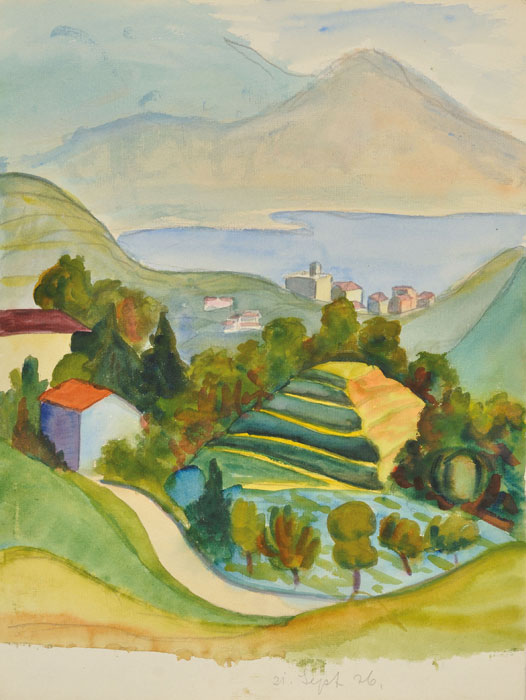
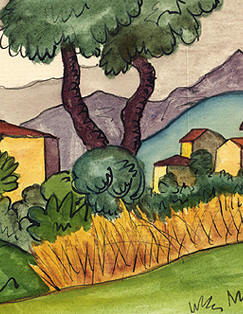
[Accessed 16/2/14: Sources:  above:  Terrassenhuegel, painted 21/9/1926, http://www.form-legal.com:  below: Village, date unknown, http://www.hermann-hesse.de]

Hesse painting 2 tree

Hemann Hesse: On Trees

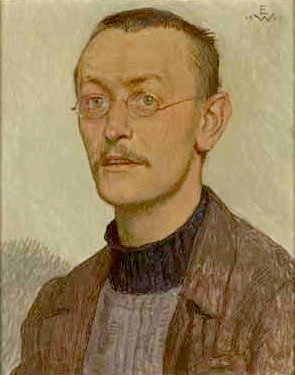
One of the rare portraits of Hesse as a young man
Bildnis Hermann Hesse. Brustbild. Tempera auf Kart. Ca. 33,5 x 27,5 cm,
Date 1905
Source kiefer.de
Artist Ernst Würtenberger (1868-1934)


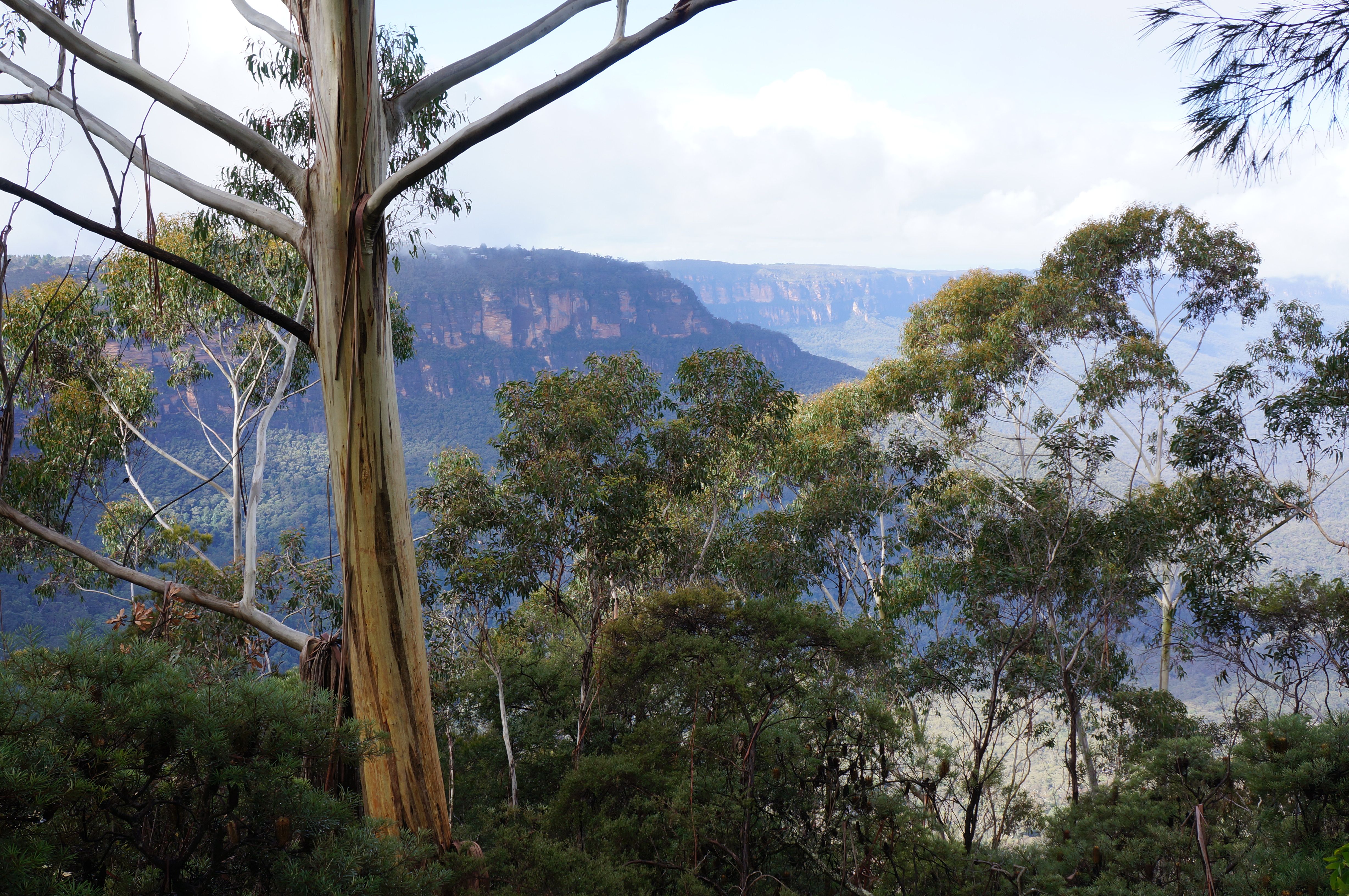
The banner photograph on this site was taken by me at Honeymoon Point, Katoomba.  I wanted to place the certainty and solidity of the tree against the void of space in the valley, stretching to the far horizon. The valleys of the Blue Mountains are replete with ancient trees, with their long breathing and restful thoughts.Hermann Hesse was particularly moved by trees. The more I look at trees, the more profound I find his thoughts.  Here is a famous passage from one of his reflective works.

For me, trees have always been the most penetrating preachers. I revere them when they live in tribes and families, in forests and groves. And even more I revere them when they stand alone. They are like lonely persons. Not like hermits who have stolen away out of some weakness, but like great, solitary men, like Beethoven and Nietzsche. In their highest boughs the world rustles, their roots rest in infinity; but they do not lose themselves there, they struggle with all the force of their lives for one thing only: to fulfil themselves according to their own laws, to build up their own form, to represent themselves. Nothing is holier, nothing is more exemplary than a beautiful, strong tree. When a tree is cut down and reveals its naked death-wound to the sun, one can read its whole history in the luminous, inscribed disk of its trunk: in the rings of its years, its scars, all the struggle, all the suffering, all the sickness, all the happiness and prosperity stand truly written, the narrow years and the luxurious years, the attacks withstood, the storms endured. And every young farmboy knows that the hardest and noblest wood has the narrowest rings, that high on the mountains and in continuing danger the most indestructible, the strongest, the ideal trees grow.

Trees are sanctuaries. Whoever knows how to speak to them, whoever knows how to listen to them, can learn the truth. They do not preach learning and precepts, they preach, undeterred by particulars, the ancient law of life.

A tree says: A kernel is hidden in me, a spark, a thought, I am life from eternal life. The attempt and the risk that the eternal mother took with me is unique, unique the form and veins of my skin, unique the smallest play of leaves in my branches and the smallest scar on my bark. I was made to form and reveal the eternal in my smallest special detail.

A tree says: My strength is trust. I know nothing about my fathers, I know nothing about the thousand children that every year spring out of me. I live out the secret of my seed to the very end, and I care for nothing else. I trust that God is in me. I trust that my labor is holy. Out of this trust I live.

When we are stricken and cannot bear our lives any longer, then a tree has something to say to us: Be still! Be still! Look at me! Life is not easy, life is not difficult. Those are childish thoughts. Let God speak within you, and your thoughts will grow silent. You are anxious because your path leads away from mother and home. But every step and every day lead you back again to the mother. Home is neither here nor there. Home is within you, or home is nowhere at all.

A longing to wander tears my heart when I hear trees rustling in the wind at evening. If one listens to them silently for a long time, this longing reveals its kernel, its meaning. It is not so much a matter of escaping from one’s suffering, though it may seem to be so. It is a longing for home, for a memory of the mother, for new metaphors for life. It leads home. Every path leads homeward, every step is birth, every step is death, every grave is mother.

So the tree rustles in the evening, when we stand uneasy before our own childish thoughts: Trees have long thoughts, long-breathing and restful, just as they have longer lives than ours. They are wiser than we are, as long as we do not listen to them. But when we have learned how to listen to trees, then the brevity and the quickness and the childlike hastiness of our thoughts achieve an incomparable joy. Whoever has learned how to listen to trees no longer wants to be a tree. He wants to be nothing except what he is. That is home. That is happiness.
― Hermann HesseBäume. Betrachtungen und Gedichte

See Post:  “Hermann Hesse’s art” for some of his tree and landscape images.


What is Art? Thoughts on bodies and animals.

The making of marks and images is embedded in human life.  From the blown ochres outlining handprints on cave walls to the ceilings in Renaissance palaces to the production of every form of visual material in today’s world productivity seems never to have faltered. Some of the most extraordinary art is made using the human body itself as canvas. Before modernity, in hunter-gatherer/horticultural societies, the artistic impulse seems already to have reached its full potential.  Without modern technologies, artists (almost everyone) understood how to obtain natural sources of colour (ochres, pipeclay, charcoals, earths) and how to use different media to mix and fix them to the body, to walls and onto the ground.  Although designs were usually inherited and traditional there was always room for innovation.  This is art in its purest, cleanest sense.  It has no environmental negatives and links the natural and bodily worlds in the deepest way.

Is art-making exclusively human? Do animals make art?  There are some amazing examples, although they seem to be limited to very specific circumstances.  [accessed 7/2/14]

http://www.ucl.ac.uk/news/news-articles/January2012/270112-art-by-animals

http://www.kshb.com/dpp/lifestyle/pets/Kansas-City-Zoo-animals-bust-out-their-paint-brushes

Art, its existence and practice, raises complex philosophical and psychological questions.  Freud and post-Freudian theorists have proposed theories about art and its meanings which are not widely known, let alone accepted, in the art world.  The political meaning and function of art has received more attention.  The changes in the significance and function of art in era of technological modernity (and near universal commercialisation) are closely related to this question, under the influence of Walter Benjamin and Theodor Adorno.  Many resist any attempts to traverse these fields and assess their implications.  Meta-theory is not necessary for the practice of art which always transcends philosophy.  But for anyone trying to practice art under contemporary conditions it can offer stimulus and insight.

One of the most fascinating aspects of the human commitment to art-making is how absolutely useless it is.  There is nothing to be gained from it in terms of the usual requirements for survival: it can’t be eaten, built with, or made to do anything other than to signify and please. Yet the desire for aesthetic pleasure seems embedded and the ability to respond to it seems part of the cognitive system.  Wherever it is possible to decorate something people will do it.  Making a basket to carry produce doesn’t require the intricate modes of weaving which so often appear, but there they are.  As soon as survival is assured and people can live somewhere above a bare subsistence, art-making appears.

Today’s systems of production mean that images are everywhere so nobody needs to feel obliged to make them in order to experience them.  Many feel they can take art or leave it.  But for others, it is something they are simply drawn to.  There are all kinds of art-making, some recognised and rewarded far more than others, but for art-makers one or more forms of expression seem to be pulling at the heart, or maybe the soul, with so much power that it can’t be resisted.

Art-making is a challenge as well as an intensely gripping activity.  I often feel the paintings I want to work on are actively demanding my attention, as if they already exist somewhere and are revealing themselves through me.  My ability to respond is limited by my inadequate technical understanding and lack of training.  Being able to make better art will meet the desires of my conscious, and unconscious, life process.

Hermann Hesse: Writing, Painting.

Hermann Hesse (1877-1962), born in Wurttemberg, Germany, was a poet, novelist and painter.  His works include Steppenwolf, Siddhartha, Demian and The Glass Bead Game.  His writings became widely known in English only in the 1960s although he had received the Nobel Prize in Literature in 1946. Hesse melded several forms of artistic endeavour with a deep interest in and respect for non-Western cultures and religious systems.

He had a troubled early life,  marked by deep depressions, associated with rebellion against the doctrines of his strict Christian upbringing.  He believed that conventional morality was, at least for artists, replaced by aesthetics.  He began writing poetry and short prose works in 1897/8 although they did not sell.  He worked in bookshops and mixed in intellectual circles, especially after moving to Basel, where he was able to explore his artistic desires and undertook many wanderings in wild places. He began writing novels and his first, Peter Camenzind, was one of Sigmund Freud’s favourites.  Literary fame followed, and he was able to support a family.  However by 1911 he was tired of domestic existence and left for a long trip to Sri Lanka, Indonesia, Sumatra, Borneo and Burma.  He hoped to find spiritual or religious enlightenment, but this eluded him, in spite of his ongoing interest in Buddhism.

During World War 1 he was not fit for active service but was given the task of caring for prisoners of war.  He opposed the tides of nationalistic madness and hatred, and called for recognition of the heritage of European histories and cultures, calling for love towards the enemy.  This resulted in hatred and public controversy, made worse for him by the death of his father, the illness of his son Martin and his wife’s developing schizophrenia. He began to undergo psychotherapy, coming to know Carl Jung personally.  In three weeks he wrote his novel Demian, published in 1919 under a pseudonym.

After his marriage ended, he moved alone to a small town on the border between Switzerland and Italy.  This began the most productive time of his life.  He began to paint, and wrote the novella Siddhartha, about the life of Buddha.  His most famous novel, Steppenwolf, was published in 1927.  He married an art historian, Ninon Dolbin, and began his major work, The Glass Bead Game, also known as Magister Ludi.  His Nobel Prize was awarded mainly for this work.

The rising tide of Nazism began, and he helped many famous artists including dramatist Bertolt Brecht and writer Thomas Mann to escape into exile.  His wife was Jewish.  By the end of the 1930s his work was totally banned in Germany.  His work was revived in the post-war era, but he was virtually unknown to English readers.

After his death, his works suddenly appeared in English translation in the United States and became bestsellers.  His writing was associated with ideas of the 1960s counterculture movement, with the quest for enlightenment and seemingly psychedelic episodes in some of his writings such as the “magical theatre” in Steppenwolf.  One reason for his popularity was the enthusiasm for his works expressed by Timothy Leary, guru of LSD.  His renaissance spread all over the world and he became the most widely read and translated European author of the twentieth century, with a huge and continuing appeal to young people.  His novel Siddartha has been translated and published widely in India, where a Hermann Hesse Society today flourishes.

Although Hesse is known for his writing, his works in visual art are vivid and vital, expressing his deep encounters with both the natural world and the towns and villages found in remote locations.  His work was entirely in watercolour, in soft bright pastel tones, with high horizons.  Almost every work included a tree, or several trees, framing and anchoring the landscapes as he viewed them.  Many of his small works illustrated his poems. Galerie Ludorff mounted a rare exhibition of these works in 2008, with the texts of the poems published in German below each illustration.

http://www.ludorff.com/de/artist/hermann_hesse/works

His poems were translated by James Wright in 1970. A selection appears at:

http://www.poemhunter.com/hermann-hesse/poems/

In recent years, as conservatism and anti-liberty sentiments grew from the 1980s onwards, Hermann Hesse’s works once again disappeared from view, remaining popular with only a small contemporary audience.  He is seen as a bit stuffy and old-fashioned, part of a pre-war European intellectual heritage.  This is a pity as his work shows deep engagement with themes of great importance today: nature, art, individual feeling, the development of an authentic and meaningful culture and the need for compassion and sympathy to all beings.  He remains one of my great inspirations.

Australian Perspectives